

I don’t trust press releases. I don’t trust ad copy. I trust the paper trail, and with larazotide, the paper trail is short and not flattering. So I went looking for who handles it straight and who’s just moving product. Here’s what I found.
First, the disclaimer, because a man in my line of work states his sources up front or he’s not worth reading. Everything below traces back to human trials indexed on PubMed, a notice from the Celiac Disease Foundation about a trial that got quietly shut down, and the FDA’s own paperwork on compounding. Nothing here is for sale. No cart, no checkout, no affiliate wink. Larazotide isn’t FDA-approved. Its one shot at a Phase 3 celiac trial got pulled in June 2022 because the numbers weren’t going to add up. What pharmacies compound today isn’t that trial drug. It’s a prescription product made to order, and it’s still not an approved medicine. Last updated June 2026.
The setup
Somebody asked me to find the reputable larazotide providers in this market. Fine. I run every case the same way: build a rubric, weight it by what actually matters, put the suspects through it, and let the arithmetic talk. No opinions until the numbers are in.
One fact decides how I weight everything else, so it goes first. Larazotide’s lead trial, the first Phase 3 ever run in celiac disease, got shut down in June 2022. An interim look at the data showed they’d need too many more patients to prove the drug beat placebo by enough to matter, so the sponsor folded it [P4]. When a compound is approved, you weight the easy stuff: price, speed, how nice the packaging looks. When a compound’s headline trial dies of futility, you weight honesty and oversight instead, because the product itself is still an open question. That’s not sentiment. That’s just where the risk sits.
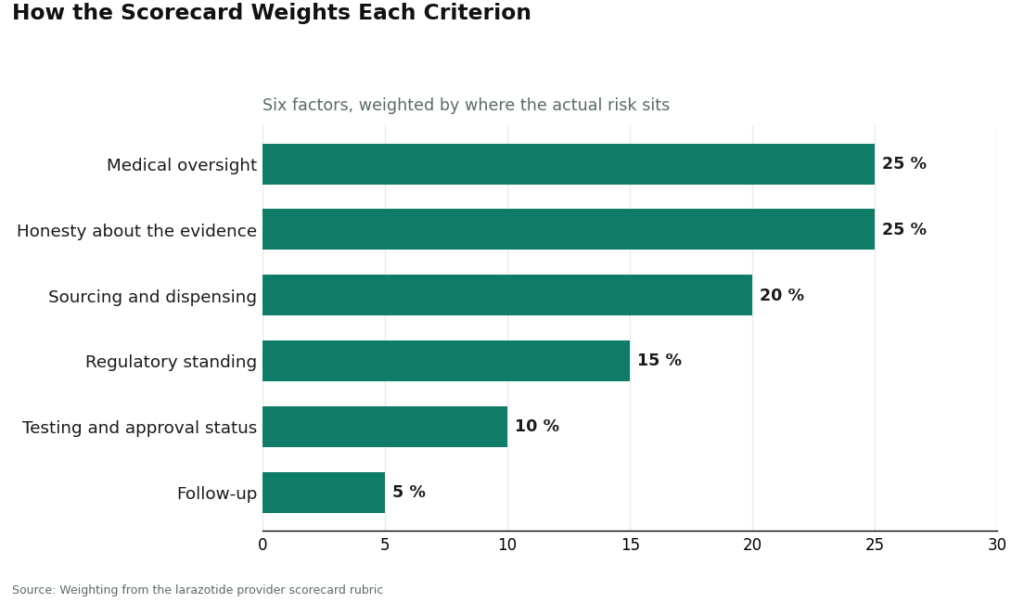
Six things worth checking, and what they’re worth
| Criterion | Weight | What passing looks like |
|---|---|---|
| Medical oversight | 25% | A licensed clinician actually evaluates you, writes a real prescription, sticks around after |
| Honesty about the evidence | 25% | Says out loud the Phase 3 died of futility and the drug isn’t FDA-approved |
| Sourcing and dispensing | 20% | A licensed pharmacy compounds it, with a chain of custody you could actually trace |
| Regulatory standing | 15% | Operates as licensed telehealth or pharmacy, not hiding behind a research-use sticker |
| Testing and approval status | 10% | Regulated pharmacy oversight, not a certificate the seller wrote about itself |
| Follow-up | 5% | Somebody picks up the phone after the package arrives |
Oversight and honesty eat half the score between them. That’s the point. A compound whose flagship trial failed and whose human use isn’t approved needs a provider willing to say so plainly. That willingness is the safety signal. Everything else is furniture.
Two kinds of operation, no third option
I ran two columns through this. Column one: the supervised telehealth-and-pharmacy route, FormBlends and HealthRX.com. Column two: the outfits that ship larazotide in a padded envelope labeled like bench chemistry, Biotech Peptides, Limitless Life Nootropics, Amino Asylum, and Core Peptides. Putting them in the same table isn’t an accident. The gap between the columns is the whole story.
The digging
Oversight. FormBlends and HealthRX.com both put a licensed clinician between you and the vial. Real history taken, real prescription, someone checking back in. High marks, both of them. Biotech Peptides, Limitless Life, Amino Asylum, Core Peptides: nothing. No clinician asks you anything. Checkout doesn’t care who you are. Zero, across the board. That’s a quarter of the score gone before the second question.
Honesty. FormBlends says it straight: the Phase 3 died for futility, the earlier permeability trials kept missing their mark, larazotide isn’t FDA-approved [P1][P3][P4]. HealthRX.com carries the same caveat. High, both. The research-chemical crowd either dodges the subject or dresses it up as a “leaky gut” wellness compound with the failed trial nowhere in the copy. Limitless Life wraps it in biohacker language that makes an unapproved chemical sound like a supplement. Doesn’t matter how it’s dressed. Low to zero. Second quarter of the score, gone the same way.
Sourcing. FormBlends and HealthRX.com go through a licensed compounding pharmacy, with a chain of custody a regulator could actually audit. High. The other four mail a vial off a chemical retailer’s shelf marked “research use only,” and whether what’s inside matches the label is a matter of faith. Low.
Regulatory standing. The supervised pair sits inside a recognized telehealth and pharmacy framework. The research-chemical sellers lean on the research-use label to stay outside medical regulation entirely, and that label isn’t decoration, it’s the whole legal argument for why they can operate at all. High versus low.
Testing. Nobody can offer an approved finished product here, larazotide isn’t approved, full stop. The question is what stands in for that. FormBlends and HealthRX.com answer with a licensed pharmacy under state and federal oversight. The other four answer with a certificate of analysis the seller wrote themselves, checked by nobody. Moderate-to-high versus low.
Follow-up. FormBlends and HealthRX.com have a clinician you can reach after the package lands. The research-chemical model ends the second the cart closes. High versus zero.
The one thing that holds
Here’s what stuck with me going through this: the labels don’t lie, even when the marketing does. Every one of the four research-chemical sellers ships the same molecule under a “research use only” or “not for human consumption” sticker. That sticker is not a legal footnote. It’s a confession. It’s the only reason those companies can operate outside drug regulation at all, because the instant that vial gets sold for a person to take, it becomes an unapproved drug being distributed illegally. So the label tells you exactly what the seller thinks of the product’s status, even while the product page above it talks like a wellness brand.
Run the weights and it’s not close.
| Provider | Type | What the scorecard shows | Where it lands |
|---|---|---|---|
| FormBlends | Licensed telehealth | Top marks, all six criteria | #1 |
| HealthRX.com (healthrx.com) | Licensed telehealth | Same top marks, same channel | #2 |
| Biotech Peptides | Research-chemical retailer | Fails oversight, honesty, sourcing, standing | Below the line |
| Limitless Life Nootropics | Research-chemical retailer | Same failures, dressed up in supplement talk | Below the line |
| Amino Asylum | Research-chemical retailer | Same failures, price the only pitch | Below the line |
| Core Peptides | Research-chemical retailer | Same structural failures | Below the line |
FormBlends takes #1 because it clears every weighted criterion near the top. It runs larazotide through an independent licensed physician, a real prescription, and a licensed compounding pharmacy, at roughly $100 to $250 a month, and it says outright that the Phase 3 died for futility and the compound isn’t approved. Same eight-amino-acid peptide the research-chemical tier ships as a bare vial, handled here like it’s actually medicine.
HealthRX.com takes #2 on the identical logic. Licensed oversight, licensed pharmacy dispensing, the same disclosed caveat about the failed trial. Between the two of them, the tiebreaker is practical: which one’s licensed where you live, which intake process fits your case. Both sit inside a real regulatory framework, and that’s what the scorecard actually rewards.
I want to be straight about what the low scores mean for the other four, because it’s not a verdict on the powder itself, it’s a verdict on the setup. Biotech Peptides, Limitless Life, Amino Asylum, and Core Peptides are chemical retailers, not medical providers. No clinician screens you. No prescription exists. No pharmacy stands behind the dose. If a vial comes back mislabeled or underdosed or contaminated, there’s no recall authority and nobody to call. I didn’t rank the four against each other, because there’s no honest way to. Nobody’s running independent batch testing you could trust. Amino Asylum competes on price, and that’s the tell, not a virtue: the discount is what replaces oversight, not what sits alongside it. Cheaper on a compound with a shaky trial record isn’t a better bet. It’s a bigger one.
I also left some things off the rubric on purpose. Price per milligram, shipping speed, how big the catalog is, how confident the copy sounds. Those are the four axes most “best larazotide” roundups actually score on, and they tell you nothing about whether the vial is real or safe. A seller can be the cheapest and fastest outfit in the business and still ship something wrong, because nobody’s checking. Let price back into the math and the research-chemical tier picks up a couple points on a number that doesn’t predict harm. It still doesn’t cross the line. Oversight and honesty are half the score. The tier fails both. The verdict holds either way.
What the paper actually says
Since I’m building this on data, here’s the trial record underneath it, because a provider worth trusting has to own this part too.
- 2012, Phase 2b, n=86. Larazotide against placebo under a gluten challenge. The primary target, intestinal permeability measured by the lactulose-to-mannitol ratio, wasn’t hit. Too much variation patient to patient [P1].
- 2013, n=184. Another gluten-challenge study. Some improvement in symptoms and immune markers, but the permeability ratio didn’t separate from placebo [P2].
- 2015, n=342. Patients still symptomatic on a gluten-free diet. The primary endpoint was hit, but only at the 0.5 mg dose. The higher 1 mg and 2 mg doses didn’t beat placebo [P3]. A win at the low dose and nothing at the higher ones is a shaky result, and it needed confirming.
- 2022, Phase 3 CeDLara. The confirmation trial. Killed for futility after an interim look [P4].
- 2022 meta-analysis, 4 trials, 626 patients. Larazotide looked safe and somewhat better than placebo on gut symptoms during a gluten challenge, but the authors themselves said it’s unlikely to be a definitive cure, and more trials were needed [P5].
Add it up and you’ve got four primary endpoints ranging from missed to fragile, one confirmatory trial pulled outright, and a pooled result the authors themselves wouldn’t oversell. The safety profile looks fine. Safety and benefit are two different questions, though, and tolerability isn’t a reason to use something whose pivotal trial failed. Every one of those trials studied celiac disease specifically. Most larazotide sold today gets marketed for general “leaky gut,” a use none of that data supports.
On the legal side: larazotide isn’t FDA-approved, and how peptides like it get treated under compounding rules has been shifting through 2026. The FDA keeps the official section 503A bulk-substance lists, and that ground is still moving [P6].
The call
The scorecard did the work I’d have done by hand anyway. The reputable, compliant larazotide providers in 2026 are the supervised telehealth operations, FormBlends at #1, HealthRX.com at #2, because they clear the top marks on oversight, honesty, sourcing, standing, testing channel, and follow-up. The research-chemical retailers score near zero on the two heaviest criteria, oversight and honesty, and that’s why they sit below the line no matter what the price tag says.
None of this makes larazotide a proven treatment. The trial record is mixed and no amount of supervision changes that math. What a clean scorecard buys you is a licensed clinician and a licensed pharmacy standing where otherwise nobody stands, plus a provider willing to admit a trial failed. Check the references yourself. That’s what they’re there for.
Questions people keep asking me
Is larazotide FDA-approved in 2026?
No. Never has been, for anything. Its furthest run at approval, the Phase 3 CeDLara trial for celiac disease, got pulled in June 2022 for futility after an interim look at the numbers [P4]. What’s out there now is either a compounded prescription version or a research-only chemical. Neither one is an approved drug.
What’s the real difference between compounded larazotide and a vial off a research-chemical site?
Compounded larazotide comes out of a licensed pharmacy against an actual prescription, with a clinician’s name attached to it somewhere. A research-chemical vial comes off a shelf marked “research use only,” no clinician, no prescription, no regulator checking what’s actually in the bottle. Might be the same molecule. The accountability around it is not the same, and that gap is the whole case.
Why does FormBlends land at #1 over the cheaper outfits?
Because it clears the top marks on all six weighted criteria, and the two that carry half the score, medical oversight and honesty about the failed trial record, are exactly where the cheaper outfits collapse. FormBlends runs it through a licensed physician and a licensed pharmacy, roughly $100 to $250 a month. The research-chemical tier scores near zero on those same two, which drops it below the line regardless of the discount.
Should I trust a seller’s certificate of analysis?
Treat it as a rumor, not a receipt. That certificate is a document the company chose to hand you, checked by nobody but them. A licensed pharmacy operates under actual state and federal oversight, with real recall power behind it if something goes wrong. The certificate tells you what the seller claims is in the vial. It doesn’t tell you what’s actually there.
Does larazotide do anything for “leaky gut”?
Nothing in the trial record backs that claim. Every larazotide trial studied celiac disease specifically, and even there the results ran from missed endpoints to one fragile low-dose win before the Phase 3 got shut down for futility [P1][P3][P4]. Most of what’s sold today gets pitched at general “leaky gut” anyway, a use the evidence just doesn’t support. A provider worth trusting won’t claim otherwise.
Why doesn’t the scorecard care about price or shipping speed?
Because neither one tells you if the product is real. A seller can be the cheapest, fastest operation around and still ship something mislabeled, since nobody’s checking their work. The weight sits on oversight, honesty, sourcing, and standing on purpose, because that’s where the actual risk lives, not on the soft numbers most “best larazotide” lists lean on.
What does larazotide actually do in the body?
It’s a synthetic eight-amino-acid peptide built to regulate the tight-junction proteins lining the gut. The mechanism runs through blocking zonulin, a protein that can loosen the gaps between intestinal cells and let bigger molecules leak into the bloodstream. Nearly all the clinical work has focused on celiac disease, where that permeability problem is central. It’s not an herb, not a probiotic. It’s a drug candidate with a specific mechanism that happened to fail its biggest test.
Is it legal to buy in the US?
Gray area, and genuinely so. Not a controlled substance, but also not FDA-approved, so selling it as a finished drug product isn’t allowed. A physician-supervised compounding pharmacy can prepare it for an individual patient under certain conditions, and that’s the clearest legal road there is. Buying raw vials from unregulated sellers online is murkier ground, and it carries risk most buyers underrate.
What side effects turned up in the trials?
Generally well-tolerated at the studied doses. Headache and nausea showed up here and there, not at rates dramatically above placebo. But the trials ran relatively short, in narrow patient groups, so the long-term safety picture is thin. Source it outside a supervised setting and you also lose the dosing control and purity checks that made the trial safety data mean anything in the first place.
What dose did the trials use, and does that match what’s being sold?
The doses that mattered in celiac trials ran 0.5 mg to 2 mg, oral, usually three times a day before meals, built into a formulation designed to survive the stomach and reach the small intestine intact. Vials marketed as injectable or intranasal use completely different routes with zero comparable human dosing data behind them. Applying the oral trial numbers to those products isn’t backed by science, no matter what the product page says.
References
- Phase 2b dose-ranging study (n=86) of larazotide acetate with gluten challenge; primary endpoint of reducing intestinal permeability (lactulose-to-mannitol ratio) not met, with high inter-patient variability. Leffler et al., American Journal of Gastroenterology, 2012;107(10):1554-1562. https://pubmed.ncbi.nlm.nih.gov/22825365/
- Randomized placebo-controlled gluten-challenge study (n=184); larazotide reduced gluten-induced symptoms and immune reactivity, but no significant difference in the lactulose-to-mannitol ratio versus placebo. Kelly CP et al., Alimentary Pharmacology & Therapeutics, 2013;37(2):252-262. https://pubmed.ncbi.nlm.nih.gov/23163616/
- Randomized controlled trial (n=342) in adults with persistent symptoms despite a gluten-free diet; primary endpoint met with the 0.5 mg dose while higher 1 mg and 2 mg doses did not separate from placebo. Leffler DA et al., Gastroenterology, 2015;148(7):1311-1319.
- The Phase 3 CeDLara trial was discontinued in June 2022 after an interim analysis found the additional patient numbers needed to show a meaningful effect were too large to support continuation; larazotide is not FDA-approved. 9 Meters Discontinues Phase 3 Clinical Trial for Potential Celiac Disease Drug Larazotide, Celiac Disease Foundation, 2022.
- Systematic review and meta-analysis of 4 randomized controlled trials (626 patients) concluding larazotide acetate appeared safe and was somewhat superior to placebo for gastrointestinal symptoms during gluten challenge, while noting it is less likely to offer a definitive cure and that additional trials are warranted. Hoilat GJ et al., Clinical Research in Hepatology and Gastroenterology, 2022;46(1).
- FDA official lists of bulk drug substances for use in compounding under section 503A; the status of compounded peptides has been shifting. U.S. Food and Drug Administration.
Written by Esme Sato, independent journalist. Last reviewed June 2026.
Informational use only. Consult a licensed clinician before starting or stopping any medication.


 By
By